【English | 中文】
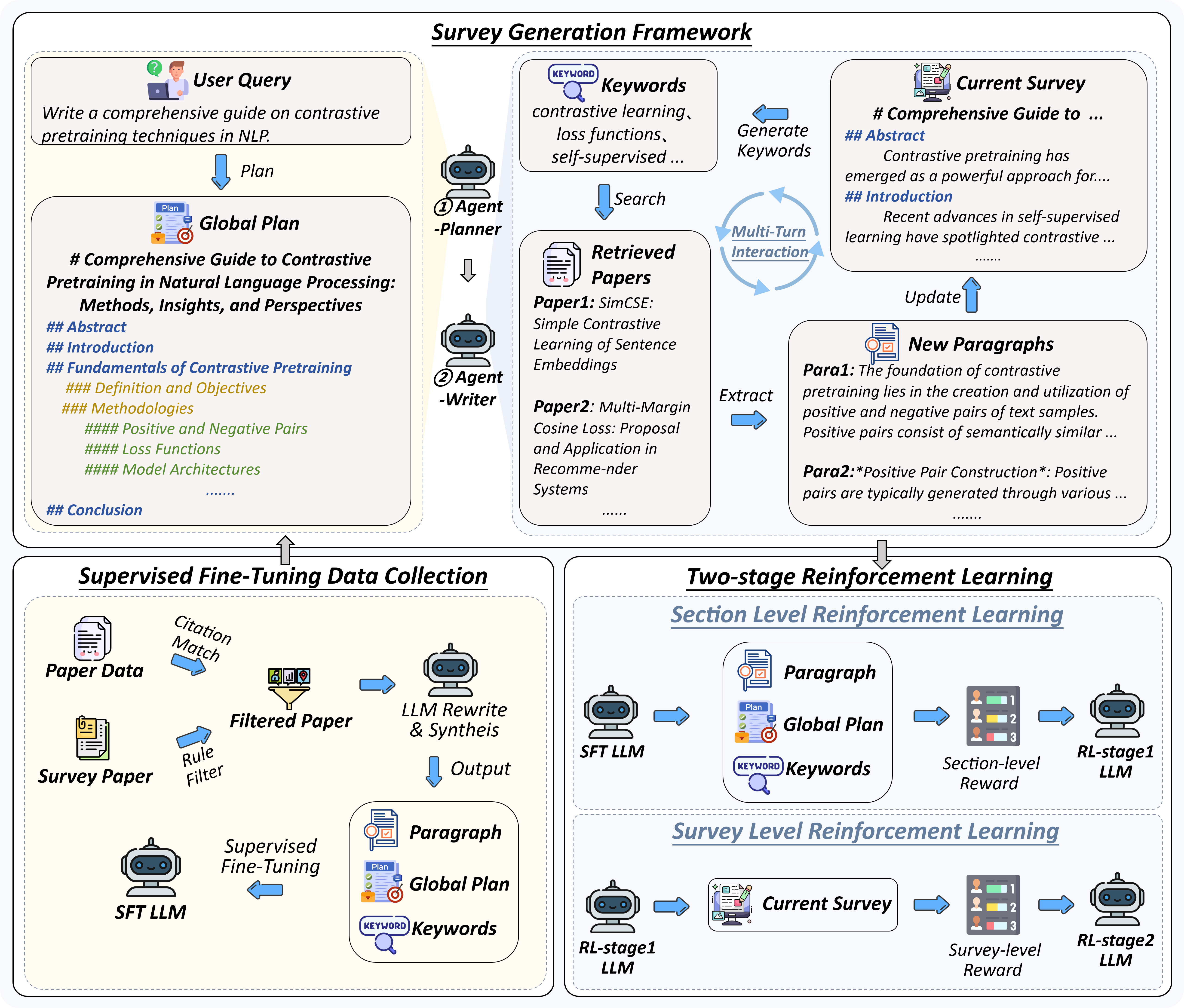
## News * [2025-06-05] 🚀🚀🚀我们开源了基于MiniCPM4-8B构建的MiniCPM4-Survey,能够生成可信的长篇调查报告,性能比肩更大模型。 ## 概览 MiniCPM4-Survey是由[THUNLP](https://nlp.csai.tsinghua.edu.cn)、中国人民大学和[ModelBest](https://modelbest.cn)联合开发的开源大语言模型智能体。它基于[MiniCPM4](https://github.com/OpenBMB/MiniCPM4) 80亿参数基座模型,接受用户质量作为输入,自主生成可信的长篇综述论文。 主要特性包括: - 计划-检索-写作生成框架 — 我们提出了一个多智能体生成框架,包含三个核心阶段:计划(定义综述的整体结构)、检索(生成合适的检索关键词)和写作(利用检索到的信息,生成连贯的段落)。 - 高质量数据集构建——我们收集并处理大量人类专家写作的综述论文,构建高质量训练集。同时,我们收集大量研究论文,构建检索数据库。 - 多方面奖励设计 — 我们精心设计了包含结构、内容和引用的奖励,用于评估综述的质量,在强化学习训练阶段作奖励函数。 - 多步强化学习训练策略 — 我们提出了一个上下文管理器,以确保在促进有效推理的同时保留必要的信息,并构建了并行环境,维持强化学习训练高效。 **Demo**: https://github.com/user-attachments/assets/b47b1567-8af1-4be0-bec4-8f86f2207d60 ## 使用 ### 下载模型 从 Hugging Face 下载[MiniCPM4-Survey](https://huggingface.co/openbmb/MiniCPM4-Survey)并将其放在model/MiniCPM4-Survey中。 我们建议使用[MiniCPM-Embedding-Light](https://huggingface.co/openbmb/MiniCPM-Embedding-Light)作为表征模型,放在model/MiniCPM-Embedding-Light中。 ### 准备环境 从 Kaggle 下载论文数据,然后解压。运行`python data_process.py`,处理数据并生成检索数据库。然后运行`python build_index.py`,构建检索数据库。 ``` bash curl -L -o ~/Downloads/arxiv.zip\ https://www.kaggle.com/api/v1/datasets/download/Cornell-University/arxiv unzip ~/Downloads/arxiv.zip -d . mkdir data python ./src/preprocess/data_process.py mkdir index python ./src/preprocess/build_index.py ``` ### 模型推理 运行以下命令来构建检索环境并开始推理: ``` bash python ./src/retriever.py bash ./scripts/run.sh ``` 如果您想使用前端运行,可以运行以下命令: ``` bash python ./src/retriever.py bash ./scripts/run_with_frontend.sh cd frontend/minicpm4-survey npm install npm run dev ``` 然后你可以在浏览器中访问`http://localhost:5173`使用。 ## 性能 | Method | Relevance | Coverage | Depth | Novelty | Avg. | Fact Score | |---------------------------------------------|-----------|----------|-------|---------|-------|------------| | Naive RAG (driven by G2FT) | 3.25 | 2.95 | 3.35 | 2.60 | 3.04 | 43.68 | | AutoSurvey (driven by G2FT) | 3.10 | 3.25 | 3.15 | **3.15**| 3.16 | 46.56 | | Webthinker (driven by WTR1-7B) | 3.30 | 3.00 | 2.75 | 2.50 | 2.89 | -- | | Webthinker (driven by QwQ-32B) | 3.40 | 3.30 | 3.30 | 2.50 | 3.13 | -- | | OpenAI Deep Research (driven by GPT-4o) | 3.50 |**3.95** | 3.55 | 3.00 | **3.50** | -- | | MiniCPM4-Survey | 3.45 | 3.70 | **3.85** | 3.00 | **3.50** | **68.73** | | *w/o* RL | **3.55** | 3.35 | 3.30 | 2.25 | 3.11 | 50.24 | *GPT-4o对综述生成系统的性能比较。“G2FT”代表Gemini-2.0-Flash-Thinking,“WTR1-7B”代表Webthinker-R1-7B。由于Webthinker不包括引用功能,OpenAI Deep Research在导出结果时不提供引用,因此省略了对它们的FactScore评估。我们的技术报告中包含评测的详细信息。*